The Cost of Solving the Wrong Problem
Why local optimization can create enterprise-wide friction
Organizations spend enormous amounts of time and money solving problems - they launch initiatives, they implement new technology, they redesign processes, they restructure teams, they grow partnerships, they introduce new products and services, and they invest in employee and customer experiences.
And yet, some problems keep coming back.
The technology gets upgraded, but adoption remains low.
The process gets redesigned, but employees continue to work around it.
The organization gets restructured, but collaboration doesn't improve.
The customer experience gets optimized, but customer satisfaction doesn't move.
The transformation initiative delivers its milestones, but the organization doesn't achieve the outcome it expected.
Sometimes the problem isn't execution. Sometimes we're solving the wrong problem.
The hidden cost of the wrong problem
When organizations solve the wrong problem, the cost isn't simply the money spent on the solution. The real cost can be much greater. It can include:

Time
Leadership attention and organizational capacity are consumed by initiatives that don't address the underlying issue.

Money
Resources are invested in solutions that optimize one part of the organization without improving the larger system.

Complexity
New processes, technologies, governance structures, and workarounds are added to an already complicated environment.

Change Fatigue
Employees experience another initiative, another transformation, and another solution that doesn't seem to make their work meaningfully better.

Opportunity
While an organization is focused on solving the wrong problem, the right opportunity may be sitting somewhere else.

Trust Erodes - Probably The Most Important
While an organization is focused on solving the wrong problem, the right opportunity may be sitting somewhere else.
The problem with local optimization
One of the most common reasons organizations solve the wrong problem is local optimization.
A team identifies an issue within its area of responsibility and works to improve it.
The technology team improves the platform.
The operations team improves the process.
The HR team improves the employee experience.
The product team improves the product.
The marketing team improves the customer journey.
Each team may successfully optimize its own area. But organizations don't experience these components separately.
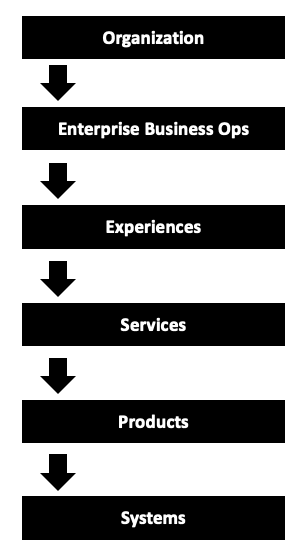
People experience the whole system, not just a component.
A new technology platform might be more efficient, but if the surrounding process is broken, the overall experience may not improve.
A new organizational structure might look more logical on paper, but if decision rights, incentives, and governance remain unchanged, behavior may not change.
A new customer-facing experience might be beautifully designed, but if the underlying systems and operations cannot support it, the experience will eventually break down.
The individual solution isn't necessarily wrong.
The elevation at which the problem was defined may be too narrow.
Symptoms are not always the problem
Consider a simple example - an organization notices that employees aren't using a new digital tool.
The immediate problem appears to be technology adoption.
So the organization responds:
More training.
Better communications.
Additional support.
New incentives.
But what if employees aren't using the tool because it doesn't fit the way work actually happens?
Now the problem may be an operating model issue. Or perhaps teams have different processes and requirements that the tool wasn't designed to accommodate.
Now we're looking at an organizational issues. Or perhaps the organization implemented the tool without first aligning its technology strategy, business priorities, and ways of working.
Now we're looking at an enterprise transformation issue. Or perhaps the enterprise groups are not aware or discussion the solution holistically.
The visible symptom stayed the same. But the problem changed depending on the elevation from which we viewed it.
That's why problem definition matters so much.
Before solving, step back
Good problem solving doesn't begin with: "What solution should we implement?"
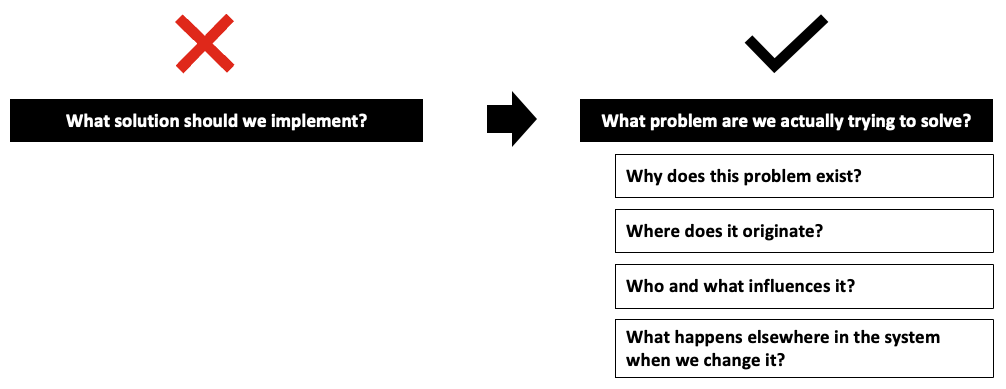
It begins with: "What problem are we actually trying to solve?"
And then:
"Why does this problem exist?"
"Where does it originate?"
"Who and what influences it?"
"What happens elsewhere in the system when we change it?"
These questions force us to move beyond the immediate symptom. They help us understand the relationships between:
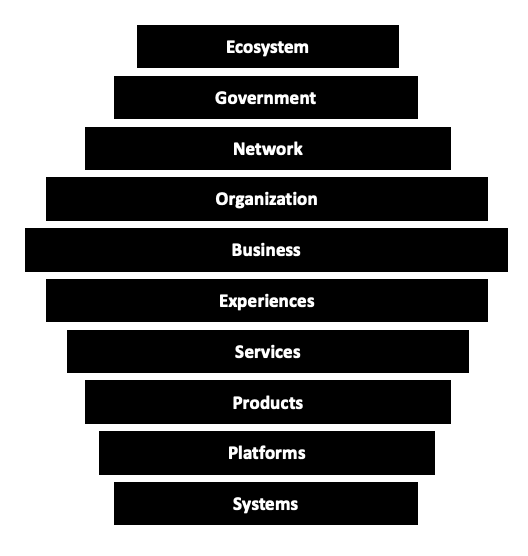
Each elevation provides another perspective. And sometimes the most important insight comes from moving one level up or one level down.
Zooming out changes the solution
Imagine a company experiencing declining customer satisfaction.
The obvious response might be to redesign the customer experience.
But zoom out.
Perhaps customer satisfaction is being affected by:
Inconsistent policies across business units.
Or by an operating model that creates handoffs between teams.
Or by incentives that prioritize efficiency over customer outcomes.
Or by disconnected technology platforms.
Or by a fragmented partner ecosystem.
Suddenly, the customer experience isn't the entire problem. It's the place where the problem becomes visible.
This distinction is critical. The place where a problem appears isn't necessarily the place where it should be solved.
The cost of solving the wrong problem compounds
The danger is that one incorrect assumption can create a chain reaction.
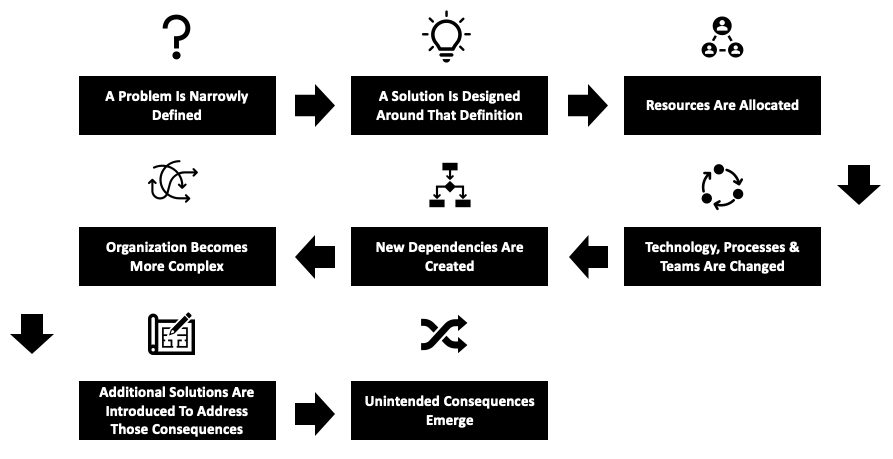
Eventually, the organization may be spending significant resources managing the consequences of an original problem that was never properly understood.
Complexity becomes the cost of solving the wrong problem repeatedly.
The leadership opportunity
Systems thinking offers a different approach. It doesn't mean making every problem bigger or turning every decision into an enterprise-wide initiative. It means understanding when the problem requires a broader perspective.
Sometimes the right answer is to zoom in. Sometimes the right answer is to zoom out. And sometimes the most valuable work happens in connecting the two.
Effective leaders can move between elevations, understand the relationships between them, and determine where intervention will create the greatest value.
They ask not only: "What can we improve?" but "What is preventing the outcome we actually want?"
That shift can fundamentally change the solution.
Solve the problem that matters
The goal isn't to solve fewer problems.
It's to spend more energy solving the right ones.
Before investing in another initiative, another platform, another restructuring, or another transformation program, take a step back and look at the system:
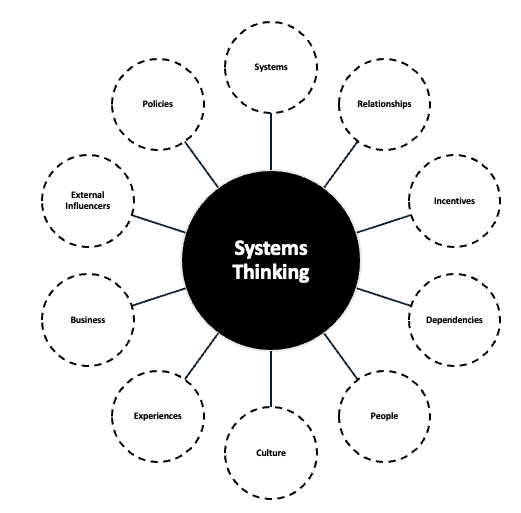
Then ask:
Are we solving the problem we have, or the problem we see?
There is a difference and understanding that difference can be the difference between optimizing what exists and transforming what is possible.
Simple Twist perspective
At Simple Twist Inc., we believe complex problems require more than isolated solutions.
They require the ability to understand how ecosystems interact:
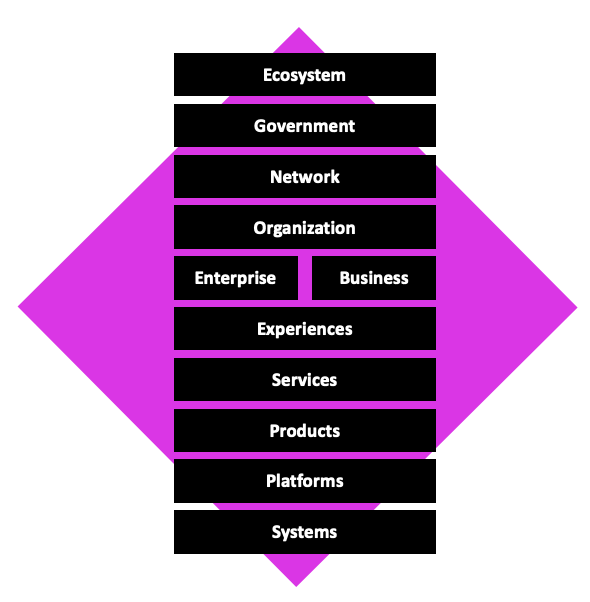
Our work starts by understanding the problem from multiple elevations, identifying the relationships and opportunities within the system, and designing solutions that create meaningful outcomes rather than simply optimizing individual parts.
Because the most expensive problem to solve may be the one you never properly defined.
Have a complex problem you're trying to solve?
Let's explore it from a different elevation.
Simple Twist Inc.
Designing Intelligent Ecosystems. Enabling Transformation. Delivering Results.