The problem you see isn’t always the problem you need to solve.
Organizations are constantly solving problems.
A customer experience isn't working.
A new technology isn't being adopted.
Teams aren't aligned.
A transformation isn't delivering the expected results.
A business process has become inefficient.
The natural response is to focus on the problem in front of us and find a solution.
But what if the problem isn't actually located where it appears?
A technology challenge may actually be a business model challenge. A business challenge may actually be an organizational design issue. An organizational challenge may be influenced by the broader network of partners, policies, incentives, or market forces surrounding the organization.
The problem you see isn't always the problem you need to solve.
Problem solving has elevations
Complex problems exist across multiple levels of a system.
At one elevation, we may be looking at a system or platform. At another, a product, service, or experience. Further out, we may need to consider the business, enterprise, organization, network, government, or broader ecosystem.
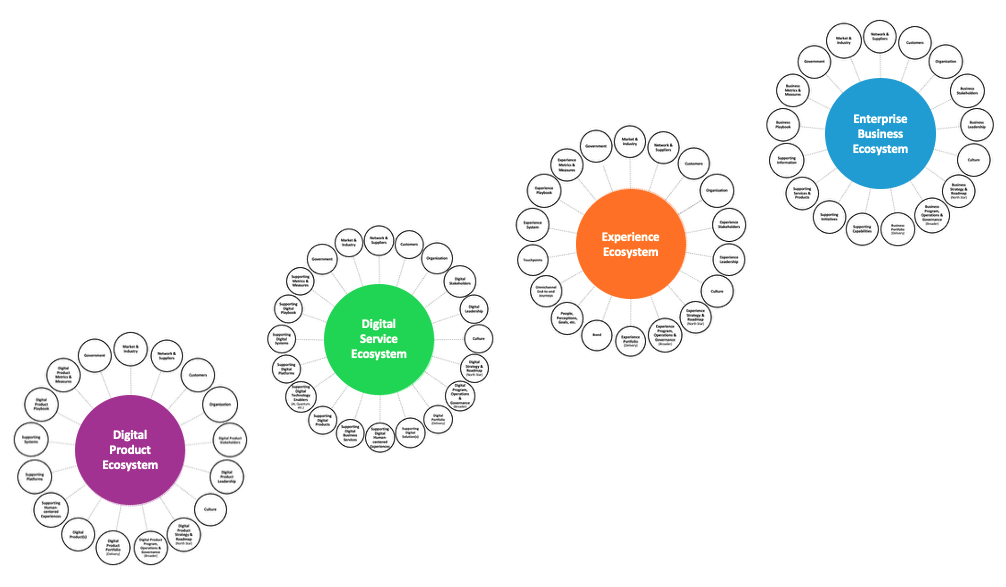
Each elevation reveals something different.
A product team may be focused on improving a product.
A service team may be focused on improving the customer journey.
A business leader may be focused on improving profitability and operability..
An experience leader may be focused on the external customer experience.
An enterprise leader may be focused on creating alignment across business units.
An organizational leader may be focused on structure, capabilities, or ways of working.
A network may introduce partners, suppliers, customers, regulators, or other stakeholders that influence the outcome.
And an ecosystem can reveal interdependencies that none of those individual perspectives can see on their own.
All of these perspectives can be correct. The challenge is knowing which elevation matters most for the problem you are trying to solve.
Zoom in
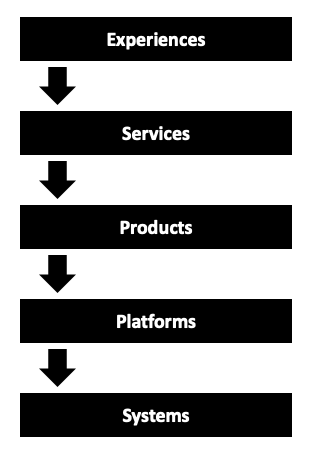
Sometimes the answer is closer than we think.
Moving down through the elevations can help us understand the components that make up an experience or system.
Experiences → Services → Products → Platforms → Systems
At these levels, leaders can examine:
How something works
How people interact with it
Where friction occurs
How technology enables or constrains behavior
Where processes break down
How products and services create value
How experiences influence adoption and engagement
This level of problem solving is essential.
But it isn't always enough.
Zoom out
Sometimes solving the immediate problem simply treats the symptom.
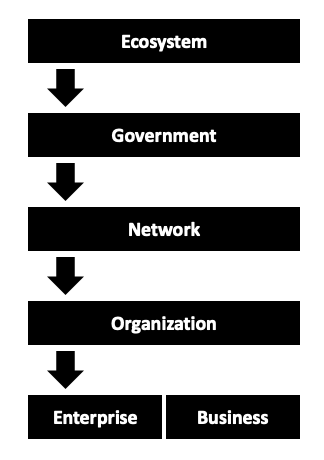
Moving upward can reveal the larger forces shaping the situation:
Ecosystem → Government → Network → Organization → Enterprise & Business
At these elevations, leaders can ask different questions:
Is the problem connected to our strategy?
Are priorities aligned across the enterprise?
Does our operating model support what we are trying to achieve?
Are organizational structures creating unnecessary friction?
Are partners and stakeholders working toward the same outcome?
Are policies or regulations influencing the problem?
What broader ecosystem dynamics are creating or reinforcing the challenge?
The farther we zoom out, the more we can see the relationships, dependencies, incentives, and constraints surrounding the problem.
The leadership capability is knowing when to move
Systems thinking isn't simply about looking at the big picture.
It is about knowing when to zoom in and when to zoom out.
Too much focus on the individual component can lead to local optimization. A team may make its product better while inadvertently making the overall customer experience more complicated.
Too much focus on the larger system can make a problem feel so complex that action becomes difficult.
Effective leaders move between the two.
They understand the component and the system.
They can see the immediate issue while asking what is creating it.
They can identify an intervention at one level while understanding how it will affect the levels around it.
The goal isn't to solve everything.
The goal is to solve the right problem, at the right elevation, with an understanding of the system around it.
From isolated problems to connected solutions
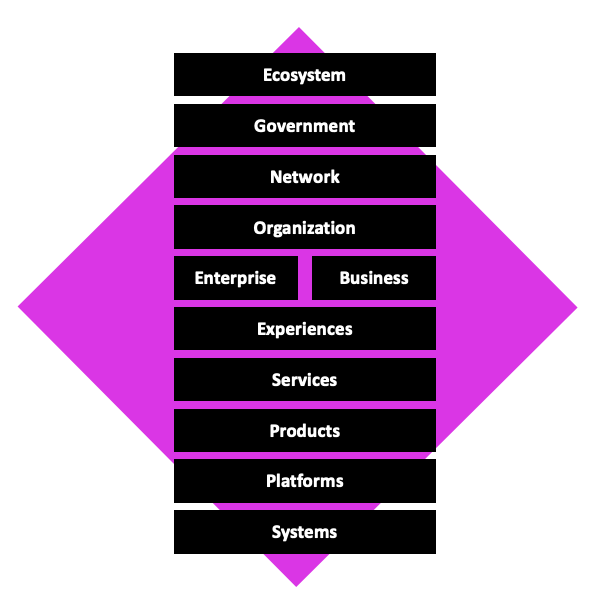
This is particularly important during transformation.
Organizations often approach transformation as a collection of initiatives:
A technology implementation here.
A workplace initiative there.
A new operating model somewhere else.
A customer experience program in another part of the organization.
Each initiative may be well designed on its own. But organizations don't experience transformation as a collection of initiatives.
They experience it as a system:
Strategy influences operating models.
Operating models influence organizations.
Organizations influence experiences.
Technology enables new ways of working.
Products and services shape customer relationships.
Partners influence capabilities.
Policies and market forces create constraints and opportunities.
Everything is connected. The opportunity is to understand those connections and design around them.
A different question for leaders
When faced with a difficult problem, instead of immediately asking:
"How do we fix this?"
Try asking:
"Where does this problem actually live?"
Then ask:
"What happens if we zoom in?"
"What happens if we zoom out?"
"What relationships become visible when we look across elevations?"
Those questions can change the solution entirely.
At Simple Twist Inc., we use systems thinking and ecosystem design to help organizations navigate complexity, connect strategy to execution, and create more integrated approaches to transformation. Our work bridges strategy, operations, technology, and human experience to help organizations move from isolated initiatives toward connected enterprise transformation.
Because sometimes the best way to solve the problem in front of you is to step back and understand the system around it.
Have a complex problem you're trying to solve?
Let's explore it from a different elevation.
Simple Twist Inc.
Designing Intelligent Ecosystems. Enabling Transformation. Delivering Results.