Why transformation increasingly requires thinking beyond organizational boundaries
For decades, organizations have focused on becoming better versions of themselves. They develop corporate strategies, optimize operating models, modernize technology, strengthen capabilities, and improve the experiences they deliver to customers and employees. These efforts remain essential as organizations need clarity of purpose, effective leadership, operational discipline, and the ability to execute.
But the strategic challenges facing many organizations extend beyond what any single organization can control. Growth may depend on partnerships. Customer outcomes may depend on external service providers. Digital transformation may rely on interconnected platforms and shared data. Supply chains may span multiple companies and geographies. Innovation may require capabilities that exist outside the enterprise.
The question for leaders is no longer only:

"How do we transform our organization?"
It is also:

"What larger ecosystem must we understand, influence, and participate in to achieve the outcomes we want?"
This is the shift from thinking primarily in terms of organizations to thinking in terms of ecosystems. It is not about abandoning organizational strategy or accountability.
It is about expanding the context in which transformation is designed and executed.
The limits of transformation within organizational boundaries
Organizational boundaries serve an important purpose. They establish accountability, allocate resources, define responsibilities, and create the structure needed to execute a strategy. They allow leaders to coordinate people, capabilities, and investments around shared priorities. But boundaries can also shape what leaders see, and what they overlook:
A business unit may improve its performance while creating dependencies or friction for another part of the enterprise.
A company may redesign its internal operations without addressing the external relationships that influence customer outcomes.
A transformation program may deliver its technology milestones while failing to change the broader operating model, partner interactions, or business capabilities needed to achieve the intended value.
These are not necessarily failures of individual teams. They are often signs that the transformation has been defined within a narrower context than the outcome requires.
When the outcome depends on a system of participants, optimizing one organization may not be enough.
The challenge for executives is recognizing where organizational boundaries support execution and where they limit the ability to create value.
Transformation is a strategic system, not a collection of initiatives
Enterprise transformation is often organized into individual programs:
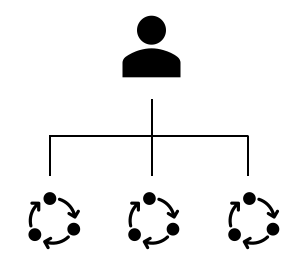
A technology modernization initiative.
A customer experience transformation.
A workplace strategy.
An operating model redesign.
A partnership initiative.
An organizational change program.
Each may have its own business case, leadership sponsor, roadmap, and performance measures. This structure can help organizations manage complex work. But it can also create a fragmented view of transformation.
The organization may track whether individual initiatives are delivering their intended outputs without fully understanding whether those initiatives are contributing to a connected enterprise outcome. For example:
A technology modernization may improve infrastructure but not address fragmented business processes.
An operating model redesign may clarify internal responsibilities but leave critical partner dependencies unresolved.
A customer experience initiative may improve a touchpoint while the underlying service ecosystem remains disconnected.
A partnership strategy may expand capabilities without clear governance or shared measures of success.
The issue is not that these initiatives lack value. It is that the value of one initiative may depend on the decisions, capabilities, and relationships surrounding it.
Executives need to understand how individual investments contribute to the broader transformation system. This requires connecting leadership, strategy, operating models, business capabilities, technology, people, experiences, products, and much more.
From enterprise strategy to ecosystem strategy
Traditional enterprise strategy asks important questions:
Where will we compete?
How will we create value?
Which capabilities do we need?
Where should we invest?
How will we execute our strategy?
An ecosystem perspective adds another layer of strategic consideration. Which outcomes depend on capabilities, relationships, and participants beyond our organizational boundaries? This can change how leaders approach growth, innovation, partnerships, and transformation.
Consider an organization pursuing a new digital business model. Its strategy may depend on:
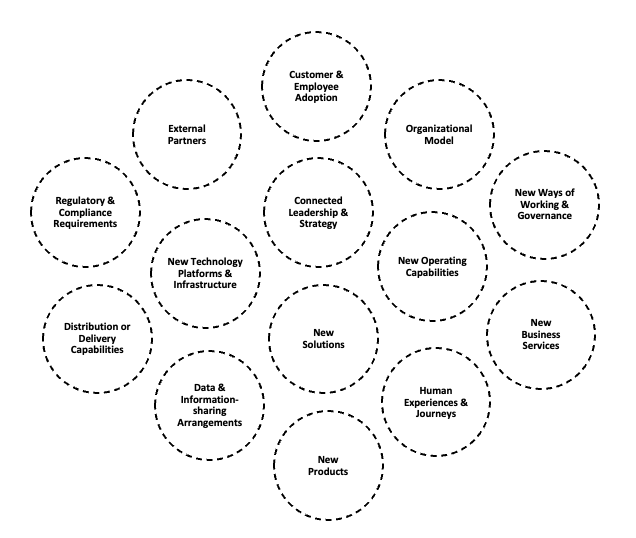
The business model may be owned by one business group, but its ability to deliver value can depend on many participants. This creates strategic questions that cannot be answered through internal planning alone:
Which capabilities should we build internally?
Which should we access through partnerships?
Where do we need stronger integration or shared standards?
What relationships are strategically critical?
Where do we have influence, and where do we have dependency?
How should we govern the ecosystem to support the intended outcome?
Ecosystem strategy extends enterprise strategy, by examining how value is created through relationships, beyond the business group or organization itself.
The relevance of this perspective depends on the business model and context. Not every organization requires the same level of ecosystem coordination, and not every strategic challenge is ecosystem-driven.
It’s the responsibility of leadership is to identify where it matters.
The operating model must support the strategy and the ecosystem
A strategy can define where an organization wants to go. An operating model helps determine how it will get there. It connects decisions about people, processes, technology, governance, and capabilities to the way the organization creates and delivers value.
But when strategic outcomes depend on external relationships, the operating model needs to account for those relationships. This raises questions such as:

Objectives
Is the goal clear?
Are all stakeholders and/or participants aligned?

Capabilities
Which capabilities must exist inside the organization?
Which can be shared, partnered, outsourced, or accessed through a broader ecosystem?

Governance
Who makes decisions when multiple organizations influence the outcome?
How are responsibilities, risks, and accountabilities defined?

Ways of Working
How do teams coordinate across organizational boundaries?
Where do handoffs, incentives, and decision rights create friction?

Data & Technology
Is there a focus on digital transformation?
How do the different platforms and systems exchange information?
Where do interoperability, security, privacy, or platform dependencies affect execution?

Performance
Are we measuring individual organizational performance or the outcomes that participants collectively need to achieve?
These are operating model and business architecture questions, but they are also strategic questions.
A decision about internal structure can influence partners. A technology investment can change dependencies. A new service model can require different governance and capabilities across organizations.
The operating model is one of the mechanisms through which strategy becomes reality, both inside the organization and in its relationships with the broader ecosystem.
The executive leadership challenge: influence beyond control
Within an organization, executives can use formal authority to align priorities, allocate resources, and make decisions. Across an ecosystem:
Leadership often depends on influence rather than direct control.
Partners have their own strategies and operating models.
Suppliers have their own priorities and constraints.
Technology providers have their own roadmaps.
Customers and communities have their own expectations.
Regulators have their own responsibilities.
The organizations involved may share some objectives while maintaining distinct interests.
This creates a leadership challenge: how do you advance a shared outcome when you do not control every participant or dependency?
The answer is not to eliminate differences or assume that everyone has the same priorities. It is to design the conditions for effective collaboration. That may include:

Strategic Alignment
Establishing a clear understanding of the outcomes that matter and where interests overlap.

Shared Accountability
Defining responsibilities and decision rights without assuming one organization can own everything.

Relationship Design
Understanding how participants interact, where dependencies exist, and what each participant contributes.

Governance
Creating mechanisms for decisions, risk management, escalation, and adaptation.

Capability Orchestration
Connecting the capabilities required to deliver value, regardless of where those capabilities reside.

Trust & Transparency
Establishing the information, expectations, and working relationships needed to support collaboration.
These are not simply relationship-management activities. They are part of the strategic and operating conditions that influence whether ecosystem-dependent transformation can succeed.
This is why an enterprise business program approach is necessary, to move forward effectively and efficiently.
The customer and employee experience crosses boundaries
Executives may organize responsibilities by business group, function, or by legal entity.
Customers and employees experience outcomes differently:
A customer may experience a service through a combination of a company's product, a partner's delivery capabilities, a technology platform, and a support process.
An employee may experience work through an interconnected set of organizational policies, digital tools, workplace services, facilities, and external providers.

The experience is often connected, even when accountability is distributed.
This creates an important leadership consideration - Where does the organization own the experience, and where does it depend on the broader system to deliver it?
For customer experience, the question may involve the entire journey across providers, channels, and supporting capabilities.
For employee experience, it may involve how workplace strategy, technology, organizational practices, and service providers come together.
For enterprise transformation, it may involve whether the organization is designing its initiatives around internal delivery milestones or the outcomes people actually experience.
The goal is not to make every organization responsible for every part of an experience. It is to identify the points where collaboration, integration, or a different operating model could improve the outcome.
A seamless experience often requires intentional coordination across organizational boundaries.
Technology enables connection. Strategy creates direction.
Digital platforms, cloud services, data-sharing capabilities, and AI are expanding what organizations can connect and coordinate. They create opportunities to automate work, exchange information, access capabilities, and deliver new products and services.
But technology alone does not resolve the strategic questions that arise when organizations become more interconnected:
A platform may connect participants without creating alignment.
AI may increase the speed of decisions without clarifying who is accountable for those decisions.
Data integration may improve access to information without resolving conflicting priorities or governance responsibilities.
Automation may optimize an individual process without addressing the broader system in which that process operates.
This is why technology transformation needs to be connected to business strategy, operating models, governance, and human experience.
Connection creates possibility. Strategic intent, effective design, and responsible governance help determine how that possibility creates value.
Executives need to consider both the capabilities technology enables and the organizational and ecosystem conditions required to use those capabilities effectively.
How leaders can approach ecosystem-oriented transformation
Thinking beyond organizational boundaries does not mean expanding every initiative into an enterprise-wide or ecosystem-wide program.
It means being deliberate about the context in which a problem is understood and a solution is created.
A practical approach begins with understanding the lifecycle and what questions to ask:
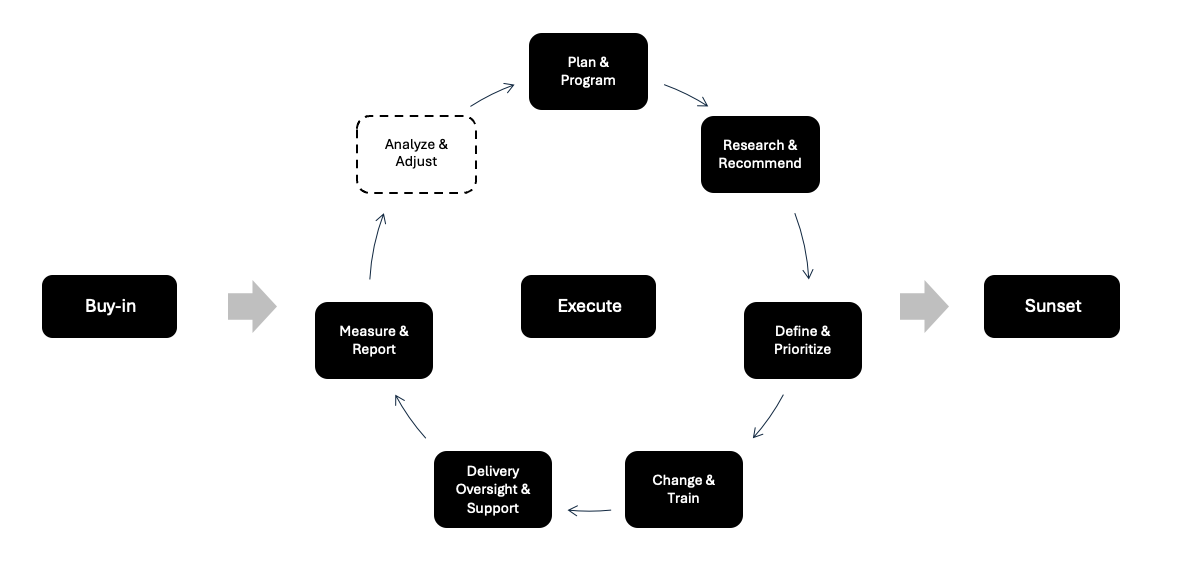
1. Plan & Program
Who is the sponsor?
What are we actually trying to achieve?
Is the goal growth, customer value, employee experience, operational resilience, innovation, cost efficiency, or something else?
What is the approach and how is the work going to get done?
A clear outcome helps align goals and determine which participants and dependencies matter.
2. Research & Recommend
What ecosystem components are needed?
Who influences the outcome?
Identify external partners, internal business groups, customers, partners, suppliers, technology providers, regulators, and other relevant stakeholders. The scope should reflect the specific strategic challenge, not an assumption that every participant is equally important.
3. Define & Prioritize
Where do capabilities, decisions, processes, solutions, and information cross organizational boundaries, where do they overlap, or where are there gaps?
Where are the challenges?
What does the future state look like?
How do we go from current-to-future state?
Consider capabilities, accountability, processes, decision rights, experiences, solutions, technology, data, and shared measures of success. Ideate on a future state and prioritize initiatives going from current-to-future state.
4. Change & Train
Who is involved in the new prioritized initiative?
What is their level of digital maturity?
What materials are necessary, and level of support, for understanding and adopting the new information and changes?
Identify team’s maturity level, then provide enough education and understanding to move forward.
5. Delivery Oversight & Support
Is the initiative executing as intended?
Are there roadblocks (people unwilling to change)?
Are there additional questions and is additional support needed?
Keep an eye on execution and connection of new groups. Provide coaching and execution updates.
6. Measure & Support
How will we know whether the transformation is creating the intended outcome?
Align measures across individual initiatives and the broader strategic objective. Adjust as necessary.
These steps are not a rigid sequence. They can be revisited as the strategy, relationships, and operating context evolve. Ecosystems constantly evolve. As you execute the lifecycle, you will constantly analyze and adjust.
The central principle is to understand the system before deciding where and how to intervene.
From organizational optimization to ecosystem value
Organizations will continue to need strong internal strategies, operating models, capabilities, and leadership.
The opportunity is to complement those strengths with a broader understanding of the systems in which they operate:
For some organizations, this may mean redesigning partnerships.
For others, it may mean changing an operating model, strengthening business architecture, connecting digital capabilities, or improving how customer and employee experiences are delivered.
For others, it may mean developing new business models or creating shared capabilities across an industry.
There is no single ecosystem strategy that applies to every organization. But there is a growing need for leaders to understand how their organizations participate in systems of value and how their strategic decisions affect those systems.
Organizations that create meaningful transformation are not only those that improve what happens within their boundaries. They are also those that understand when the outcome depends on what happens beyond them.
A different question for executives
As you consider your next strategic initiative, transformation program, or operating model decision, ask:
What outcome are we trying to create?
Which parts of that outcome depend on participants beyond our organization?
Where do our organizational boundaries enable execution, and where do they create friction?
What relationships, capabilities, and governance arrangements need to evolve?
Are we optimizing our organization, or are we designing for the larger outcome we are part of creating?
These questions do not replace execution. They help ensure that execution is connected to the strategic context that matters.
Transformation is not only about changing the organization. It is about designing the conditions in which the organization can create value, within its boundaries and through the ecosystem around it.
Real-world Example: When the problem isn’t the campus, it’s the ecosystem
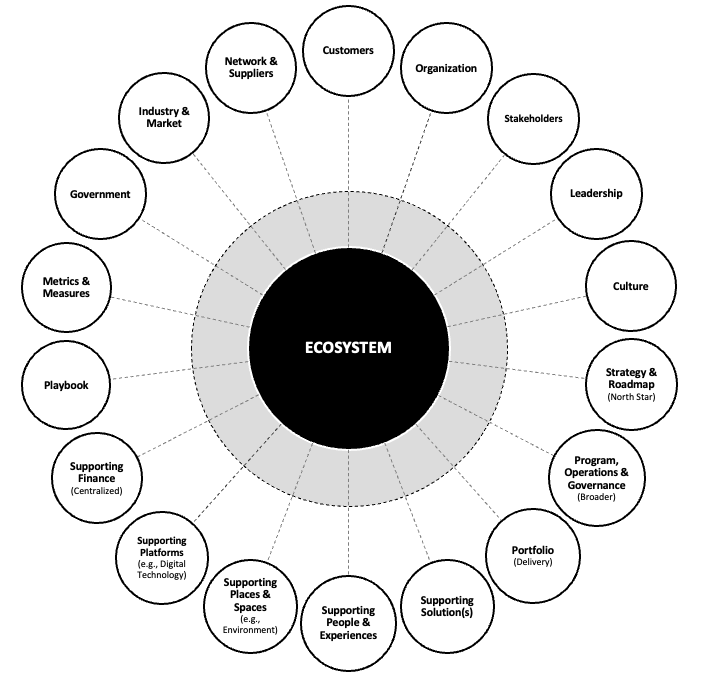
At a Big Tech company, creating a seamless, intelligent campus had become increasingly difficult. Employees, stakeholders, and suppliers were navigating disconnected services, systems, spaces, and processes.
The organization initially had many individual efforts underway, but the problem was, no one had a shared view of how they connected.
We shifted the question from “How do we improve each component?” to “How does the ecosystem work together?”
We mapped industry, organization, leadership, partners, strategy, operations, portfolio, solutions, experiences, physical environments, technology, and so much more. This revealed the dependencies and gaps that individual initiatives couldn't see on their own.
The result was a shared framework for creating a more connected, intuitive smart campus.
The breakthrough wasn't optimizing one part of the system. It was understanding the system as a whole.
The Simple Twist perspective
At Simple Twist Inc., we help organizations navigate complex transformation by connecting strategy, business architecture, operating models, people, technology, experiences, and ecosystems.
We believe meaningful transformation begins with understanding the outcome, the system that influences it, and the capabilities and relationships needed to move from intent to execution.
Our approach combines systems thinking, human-centered design, enterprise business architecture, and transformation strategy to help leaders make informed decisions about where to focus, how to align, and how to create lasting value.
Whether the opportunity involves enterprise transformation, modern work, digital and AI capabilities, operating model design, or ecosystem strategy, the work starts with understanding how the pieces connect.
Because the next opportunity for transformation may not exist within your organization alone. It may exist in the connections between your organization and the world around it.
Have a complex problem you're trying to solve?
Let's explore it from a different elevation.
Simple Twist Inc.
Designing Intelligent Ecosystems. Enabling Transformation. Delivering Results.