Human-centered Design: Beyond the Interface, Transforming the Enterprise
Applying Human-centered Design to solve complex problems, connect business and technology, and create meaningful experiences and enterprise-wide value.
Human-centered Design (HCD) is often associated with designing products, applications, websites, and customer experiences. While these are important applications, the discipline extends far beyond the design of individual interfaces or touchpoints.
At its core, Human-centered Design is an approach to understanding people, their needs, behaviors, motivations, and challenges, and using those insights to inform better decisions, solve problems, and create meaningful solutions.
When applied across an organization, HCD becomes a powerful capability for connecting people, business strategy, operating models, processes, information, technology, and experiences. It shifts the focus from designing around individual functions or predetermined solutions to understanding the broader human and organizational context in which problems exist.
The opportunity is not simply to make things easier to use. It is to make organizations, their services, solutions, and experiences work better for the people who depend on them.
01 What is Human-centered Design?
Human-centered Design is a problem-solving and innovation approach that places people at the center of understanding, defining, and designing solutions.
It begins with understanding the people affected by a problem rather than immediately defining a solution based on existing business processes, organizational assumptions, or available technologies.
Through research, observation, engagement, and collaboration, HCD uncovers the underlying needs, behaviors, motivations, expectations, and pain points that influence how people interact with an organization, its products, services, and environments.
These insights help organizations challenge assumptions, identify opportunities, reframe problems, and develop solutions that are relevant, usable, accessible, and valuable.
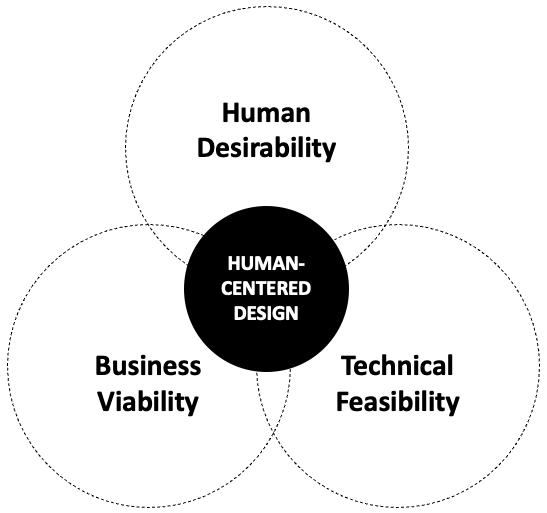
Human-centered Design considers three interconnected dimensions:
Human Desirability: What do people need, value, expect, and want to accomplish?
Business Viability: What supports organizational objectives, business value, and sustainable operations?
Technical Feasibility: What can be enabled through technology, information, infrastructure, and available capabilities?
The greatest opportunities emerge when these dimensions inform one another rather than operate independently.
HCD is not about prioritizing people at the expense of business or technology. It is about ensuring that business and technology decisions are informed by the people they ultimately serve and affect.
02 Why Is a Human-centered Design Approach Different?
Organizations frequently approach problems through a business-first or technology-first perspective.
A business-driven approach may begin with financial objectives, operational efficiency, organizational priorities, or existing processes. A technology-driven approach may begin with available platforms, technical capabilities, automation opportunities, or system requirements.
Both perspectives are important. However, when either becomes the primary lens for defining a problem, organizations risk developing solutions that address internal priorities without fully understanding the people, behaviors, and experiences involved.
Consider the difference:

Business-Driven Approach
Begins with what the organization wants to achieve.
Focuses on business objectives, operational performance, processes, resources, and organizational requirements.

Technology-Driven Approach
Begins with what technology can enable.
Focuses on platforms, systems, automation, technical capabilities, data, and integration.

Human-centered Design Approach
Begins with understanding the people and the broader context surrounding a problem.
Connects human needs and behaviors with business objectives and technology capabilities to identify the right problems to solve and the most meaningful solutions to pursue.
This distinction matters.
Without human-centered insights, organizations can invest in technology that does not address the underlying problem, optimize processes that create unnecessary friction, or design experiences around organizational structures rather than the needs of the people navigating them.
HCD introduces a different starting point: understand before designing, challenge assumptions before committing to solutions, and consider the broader implications of decisions.
03 Why Is Human-centered Design a Valuable Organizational Capability?
Human-centered Design provides organizations with a structured way to understand complexity, challenge conventional thinking, and make better-informed decisions.
Its value extends beyond improving individual experiences. It can help organizations:
Identify the right problems: Uncover underlying needs, root causes, and opportunities rather than simply addressing visible symptoms.
Improve decision-making: Introduce research, evidence, and human insights into business and technology decisions.
Connect organizational perspectives: Bring together business, technology, operational, and human perspectives that are often separated by organizational silos.
Drive innovation: Challenge assumptions and explore new ways of delivering value through products, services, experiences, and operating models.
Improve adoption and engagement: Design solutions around actual behaviors, needs, and working environments rather than assumed usage.
Reduce investment risk: Test ideas and validate assumptions before committing significant resources to implementation.
Improve business outcomes: Align solutions with human needs, organizational objectives, and measurable performance.
HCD also creates a common language for collaboration. It enables business leaders, technology teams, designers, operational stakeholders, and end users to participate in understanding problems and shaping solutions together.
Rather than treating design as a downstream activity, organizations can use it as an integral part of strategy, innovation, and transformation.
04 Solving Problems at Multiple Elevations: Beyond Interface Design
One of the most important distinctions about Human-centered Design is that it can be applied at multiple elevations across an organization.
Design is not limited to the products, applications, and interfaces people interact with. It can inform decisions at the ecosystem, enterprise, organizational, operational, solution, experience, service, product, platform, and systems levels.
A problem experienced by an employee or customer may originate far beyond the interface where the problem becomes visible.
For example, an employee struggling with a workplace application may actually be experiencing a larger organizational issue involving disconnected processes, unclear ownership, fragmented information, inconsistent services, or misaligned business and technology capabilities.
Redesigning the interface alone may improve usability, but it will not necessarily resolve the underlying problem.
Understanding the relationships between these different elevations allows designers and enterprise leaders to identify where intervention is needed and how changes at one level may affect others.
The following framework illustrates 15 interconnected elevations where human-centered thinking and design can inform problem-solving, innovation, and transformation.
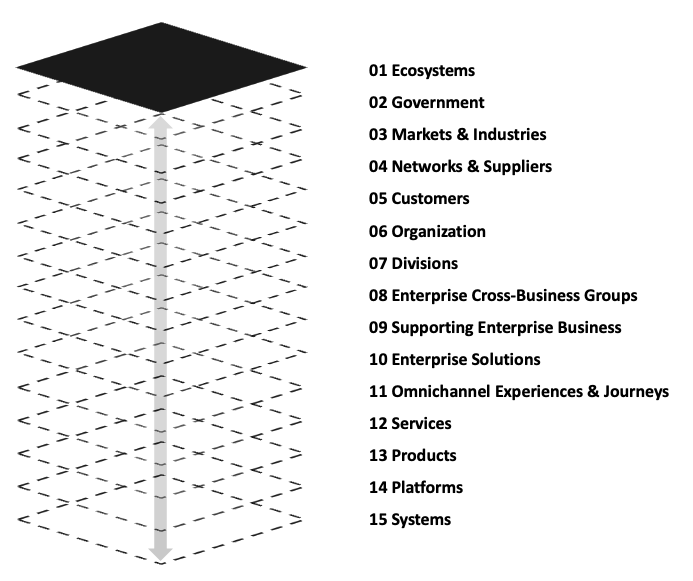
The 15 elevations include:
Ecosystems: The interconnected relationships between organizations, people, partners, markets, industries, and external environments.
Government: Policies, regulations, public institutions, and governance environments that influence how organizations operate.
Markets & Industries: Market dynamics, industry structures, competitive environments, and emerging opportunities.
Networks & Suppliers: Business networks, supply chains, strategic partnerships, and supplier relationships.
Customers: Customer segments, needs, expectations, behaviors, and relationships.
Organization: Enterprise-wide structures, strategies, cultures, capabilities, and operating models.
Divisions: Corporate divisions, business units, and functional organizations.
Enterprise Cross-Business Groups: Cross-functional and cross-business communities, such as Modern Work, that connect capabilities across the enterprise.
Supporting Enterprise Business Groups: Enabling functions such as Brand, People, Digital Technology, Real Estate, Finance, and other corporate services.
Enterprise Solutions: Integrated business and technology solutions, such as the workplace, that bring multiple capabilities together.
Omnichannel Experiences & Journeys: Enterprise business, employee, customer, supplier, and other stakeholder experiences and journeys.
Services: AI, facilities management, transportation, dining, security, support, and other services.
Products: Products and tools that enable people to accomplish tasks, such as operator and employee applications.
Platforms: Digital and physical platforms that enable products, services, experiences, and business capabilities.
Systems: The underlying information, design, experience, digital, data, workplace, and other systems that support the enterprise.
The work, focus, and resulting artifacts differ at each elevation. Each level presents its own design considerations, challenges, and opportunities. However, these elevations are interconnected, not isolated design opportunities. Decisions made at one level can influence capabilities, experiences, and outcomes across several others.
Human-centered Design provides a way to understand these relationships, consider the people affected by decisions, and examine how those decisions influence the broader enterprise ecosystem.
The objective is not to design everything at once or apply the same approach at every level. It is to identify the appropriate elevation at which to understand and address a problem, determine the work required at that level, and recognize its dependencies and implications across the enterprise.
05 Partnering with Business and Technology to Drive Innovation
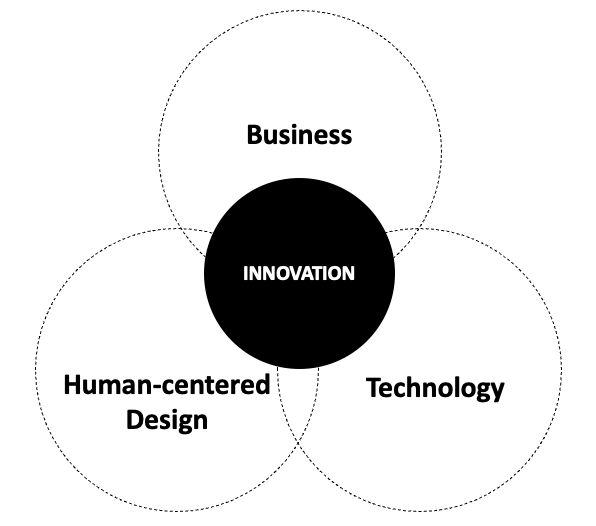
Human-centered Design is most effective when it operates in close partnership with business and technology.
These disciplines bring different but complementary perspectives.
Business leaders understand organizational objectives, market opportunities, operational requirements, financial considerations, and strategic priorities.
Technology leaders understand platforms, architecture, data, systems, infrastructure, integration, and emerging technical capabilities.
Human-centered design brings an understanding of people, behaviors, needs, motivations, interactions, and experiences.
Together, these perspectives create a more complete understanding of the opportunities and constraints surrounding a problem.
Rather than working sequentially, with business defining requirements, technology developing solutions, and design refining the interface, these disciplines should collaborate throughout the problem-solving and innovation process.
This partnership enables organizations to:
Challenge assumptions and reframe business problems.
Identify unmet human needs and emerging opportunities.
Explore new business models, services, and experiences.
Evaluate technology opportunities against actual needs.
Connect business capabilities and technology solutions.
Develop and validate new ideas before scaling.
Align stakeholders around a shared vision and desired outcomes.
The result is a more integrated approach to innovation, where people, business, and technology inform the direction and design of solutions together.
06 Human-centered Design Through an Iterative Design Process
Human-centered Design is not a linear process with a predetermined outcome. It is iterative by nature.
Understanding people, defining problems, exploring opportunities, and developing solutions requires continuous learning, testing, and refinement.
An iterative approach allows organizations to challenge assumptions, incorporate feedback, adapt to changing needs, and improve solutions as new information becomes available.
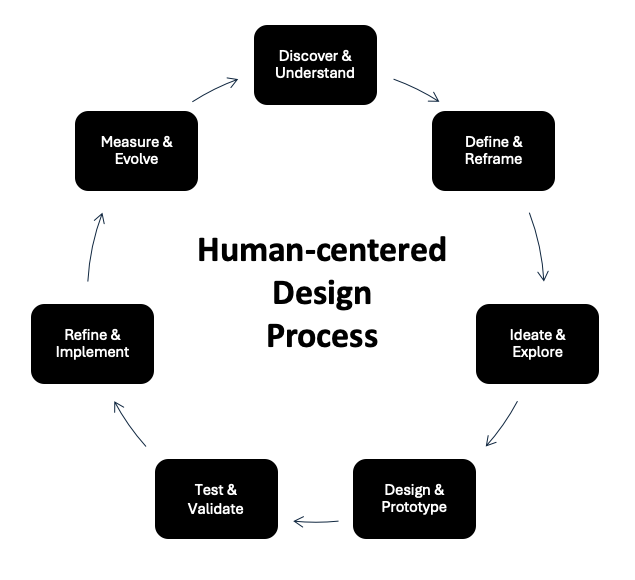
A typical Human-centered Design process includes:
Discover & Understand
Research the people, environment, behaviors, needs, and challenges surrounding the problem. Engage stakeholders, observe interactions, gather insights, and understand the broader context.
Define & Reframe
Synthesize research and insights to identify underlying problems, root causes, unmet needs, and opportunities. Establish a shared understanding of what needs to change and why.
Ideate & Explore
Generate ideas, explore alternatives, challenge assumptions, and consider different approaches to solving the problem. Bring business, technology, and human perspectives together.
Design & Prototype
Translate ideas into concepts, experiences, workflows, service models, products, or solutions. Develop prototypes and representations that make ideas tangible and testable.
Test & Validate
Engage the people affected by the proposed solutions. Gather feedback, evaluate usability and effectiveness, validate assumptions, and identify opportunities for improvement.
Refine & Implement
Incorporate insights and feedback, refine the solution, and work with business and technology partners to prepare for implementation and adoption.
Measure & Evolve
Evaluate performance against human, business, and operational objectives. Monitor outcomes, identify new opportunities, and continue improving as needs and conditions evolve.
The process is iterative, not strictly sequential. Teams may revisit earlier stages, test multiple concepts, or discover new problems as their understanding develops.
This continuous feedback loop helps ensure that solutions remain relevant, effective, and aligned with the people and organizations they serve.
07 The Outcomes of Human-centered Design
When integrated into organizational strategy, innovation, and transformation, Human-centered Design can create value well beyond the immediate solution.
Its outcomes can include:
Better-informed business decisions: Decisions grounded in research, evidence, and a deeper understanding of human needs.
Meaningful innovation: New opportunities for products, services, business solutions, and experiences.
Improved experiences: More intuitive, accessible, connected, and consistent interactions across channels and touchpoints.
Stronger organizational alignment: Better collaboration and shared understanding across business, technology, and operational teams.
More effective operating models: Processes, roles, and capabilities designed around how people and organizations actually work.
Improved technology adoption: Solutions that better reflect user needs, behaviors, and real-world working environments.
Reduced risk and rework: Earlier validation of ideas, assumptions, and requirements.
Measurable business value: Improvements in performance, efficiency, engagement, service delivery, and organizational effectiveness.
Ultimately, the value of Human-centered Design is not measured by the number of workshops conducted, prototypes created, or interfaces redesigned. It is measured by the problems solved, opportunities realized, experiences improved, and meaningful outcomes achieved.
Moving Beyond Design to Transform How Organizations Think
Human-centered Design is much more than a methodology for creating better products and experiences. It is a way of thinking, understanding, and approaching complex challenges.
When combined with business strategy, technology, Systems Thinking, Systemic Design, and Ecosystem Thinking, it becomes an important capability for addressing challenges that extend across organizational boundaries.
It helps organizations look beyond individual functions, technologies, and touchpoints to understand how people, capabilities, processes, services, solutions, and systems work together.
The opportunity is to move beyond designing isolated solutions and toward designing more connected organizations and intelligent ecosystems.
Design for people. Connect the enterprise. Create meaningful, measurable impact.
Have a complex problem you're trying to solve?
Let's explore it from a Human-centered Design perspective.
Simple Twist Inc.
Understanding People. Designing Intelligent Ecosystems. Enabling Transformation. Delivering Results.